TankaTuesday#5

Hello I am back after a week of prayers, celebrations, socializing and gorging 😀 And it’s already time for Colleen’s #TankaTuesday challenge where the rules are to to write in any of the 24 syllabic forms of Japanese poetry using a kigo or season word as an inspiration. While there are 24 seasons in Japan, we are allowed to use season words as per our region.

I have used ‘Vijayadashami’ (literally victory tenth day) as the kigo word here. Vijayadashami (which was on 24th October this year) is celebrated after Navratri and is the 10th day that marks the end of Durga Puja and the celebration of Her victory over Mahishasura (the buffalo demon) and the triumph of good over evil. After the celebrations, there is a hush and lull in the neighborhood.

Vijayadashami is also celebrated as Dussehra, the day when Lord Rama defeated the evil king Raavan, whose effigies are burnt to symbolize the burning of the evils within us as well as the triumph of good over evil.

Thank you for reading, would love to know your comments and suggestion. Have a great weekend.

TankaTuesday#4

Hello! It is time for Colleen’s #TankaTuesday challenge where the rules are to to write in any of the 24 syllabic forms of Japanese poetry using a kigo or season word as an inspiration. While there are 24 seasons in Japan, we are allowed to use season words as per our region.

But before I begin, I am very chuffed that Colleen was kind enough to choose my previous entry as the poem of the week and couldnt resist sharing. Yayy and thank you again Colleen 🙂

Now off to the tanka of this week. First the tanka and then the explanatory note. Perhaps, some of you may not need the note 🙂

I have used Navratri (literally nine-nights) as the ‘kigo’ word for this tanka. In India, we are currently celebrating Navratri and today is day 3 of the festival. Navaratri is a bi-annual Hindu festival observed in honour of the Mother Goddess Durga and many devotees keep a fast during this period. A bhandara is a mass feast given to the needy by the Hindus, particularly in North India on auspicious occasions such as the Navratri.

Here’s wishing you all a very auspicious and happy Navratras to you and yours. 🙏

TankaTuesday #3

Hello! Here’s another tanka for Colleen’s #TankaTuesday challenge where the rules are to to write in any of the 24 syllabic forms of Japanese poetry using a kigo or season word as an inspiration. While there are 24 seasons in Japan, we are allowed to use season words as per our region.

First the tanka and then the explanatory note. Perhaps, some of you may not need the note 🙂

I have used Durga Puja as the kigo word. Like I mentioned in my earlier post, Navratri (or nine nights) festival in honor of Goddess Durga is being celebrated this year from 15th to 24 October. During this period, Hindu devotees worship Goddess Durga but the manner of celebration is diverse and unique in different parts of the country. This includes, but is not restricted, to dandiya, kanyapujan (little girls are worshipped as the Goddess) and Durga Puja. Durga Puja is a socio-religious celebrations that is mostly undertaken as a community but may also be done individually. It is associated with not only religious activities but also a platform for showcasing art, culture, and new clothes, cars, TVs and what have you while gorging on a variety of mouth-watering delicacies, including those served free. You may read more about Durga Puja here.

Perhaps, even ‘freshly showered’ could be considered the kigo word. Unlike the West, here in India, this is not the fall season. In fact, this is a time that is right after the monsoons which is a boon to the trees wilting in the scorching summer heat. They are now at their cleanest, greenest and happiest. With the monsoons withdrawing, the skies are blue (for once – Touch wood!!!) the breeze cool, and a palpable sense of excitement in the air. Even Mother Nature is celebrating the imminent arrival of the Mother Goddess (Durga Puja) in her inimitable way.

Did this work? Did you need the explanatory note? Looking forward to reading your reactions. Have a super day.

MWWP: The Magical Village

Hello and good day to you. Today I am participating in Eugi’s Moonwashed Weekly Prompt. The prompt is Magical Village. It can be any variation of the prompt or the image (below).

The photo is rather magical and made me throw caution to the wind and attempt a free verse. Actually, I am not even sure, if that’s what it is – anyway, here goes.

Fireflies line the path

Magical village

Hiding in plain sight

A lush rustling village

No wants and little needs

Strife there was none.


Oblivious of taunts, curses

and betrayals

Partners for life with

ample space for young’uns

Once they grew roots

they too stayed put.


Some were short, some tall

some colorful, some shy

The naked and the  bedecked

together, no bite in their bark

Phoenix rising from the ashes,

They were that magical.


Passing travellers stop by

Catch a break, 

have a stretch, grab a bite,

Scratch an itch or build a home

They leave without even

A hug, a pat or a backward glance


Once in a while

When the weather is fine,

a light wind blowing

they nod and

wave to each other

going about their daily chores


Day in and day out, these

voiceless master chefs concoct

magic out of thin air

Some make tea, some coffee

Offering children of their heart

an arm, a leg, their whole being


With no expectations

the tireless village plods on

in pursuit of its

Endless thankless task

-- Feed and sustain

20 quintillion lives and counting

Thanks for visiting and your kind comments and suggestions. Have a super weekend.

Note (8/10/23): I changed the title of the poem as I felt that otherwise the poem was very obscure for most readers. Do let me know your thoughts. Thanks

TankaTuesday #2

Good day! Another attempt to write tanka while participating in Colleen’s #TankaTuesday challenge where the rules are to to write in any of the 24 syllabic forms of Japanese poetry using a kigo or season word as an inspiration. While there are 24 seasons in Japan, we are allowed to use season words as per our region.

I am trying out a tanka and have used ‘Dandiya’ as the kigo word here. Dandiya Raas is a folk dance of western India mostly in the states of Gujarat and Rajasthan. This popular socio-religious dance is performed during the Navaratri (literally – Nine Nights) festival in honor of Goddess Durga who is believed to visit her home on Earth along with her children and their unique animal companions, (but that’s another story for another day, perhaps). This festival usually occurs in the period of late September to late October with the actual dates varying from year to year. Dandiya is performed in memory of Goddess Durga’s victory over Mahishasura (literally – buffalo demon) and the colorful sticks (called dandia) used in the dance represent her sword.

I took this image from this site just to give you a better idea. I hope the kigo word is acceptable?

And the tanka is

Initially I thought of going for just the haiku (the first 3 lines) then felt it could be a tanka as well. Also the explanation seemed a bit disproportionate to the kigo description. Still is actually 😀

That’s it folks. Do let me know your thoughts, comments and tips. Have a great day and thank you Colleen for the challenge.

One-to-Three PPC Challenge #2

Hello to you 🙂 Venturing into the domain of photography I am participating in XingfuMama’s photo challenge. The challenge is simple: take one photo and get creative with it by processing it three different ways.

Here goes:

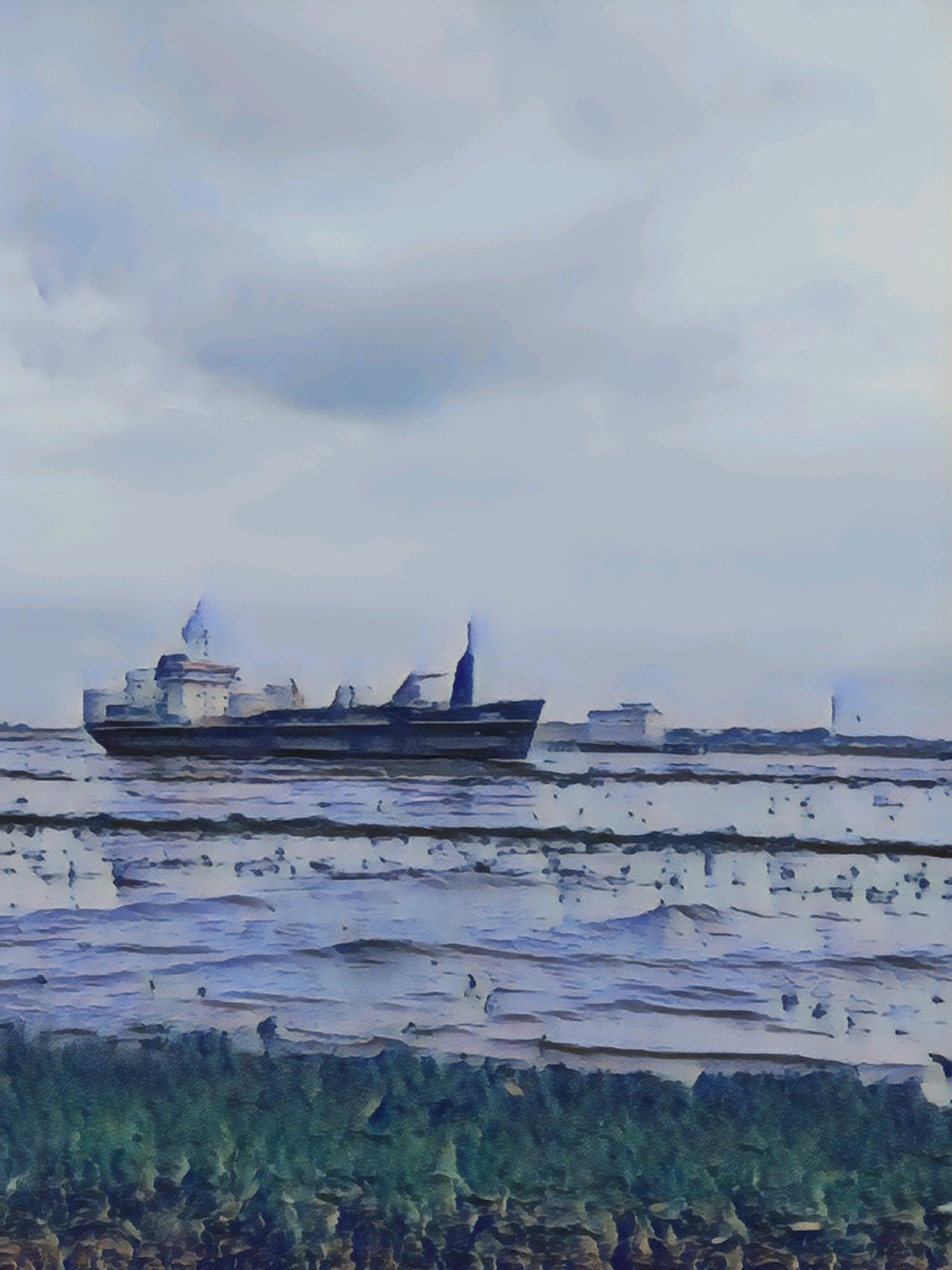
This is the original. This was taken last month at Kochi harbor in Kerala, India. It was a cloudy cool morning and it was such a treat to watch her grow bigger and bigger as she floated back home. I took it on my Samsung Z fold 2 phone camera. No particular setting.

Err, I can’t help but also post a haiku, or attempt at one, inspired by this image. Haiku, as you may know, captures one or two moments  by using clear and vivid images. A haiku, consisting of a phrase and a fragment, is an unfinished poem – the readers interpret what it means by putting the images together. Do share your thoughts and interpretations 🙂

This is the Pen and Wash style availabe in the phone itself.

This is the Watercolor style. Earlier we used to attempt watercolors (not that I ever could!) based on photos and now its the reverse. Fascinating stuff.

For this one, instead of the Styles function, I tried to play around with contrast, exposure, shadow, sharpness etc.

On second thoughts, the version one and two look quite similar, don’t they?

So, what’s the verdict? Suggestions? Tips?

Thanks for visiting. Have a super day.

WLC#40: A Circular Rainbow

Hello, hope you are having a great day. Today, I am participating in the challenge hosted by XingfuMama which is about Whatsoever is Lovely Challenge – It could be anything: a picture or you can go into detail and tell it as a reflection, story or poem.

So it’s a picture with some detail, processing and a poem 🙂

Recently while on an early morning flight, I was surprised and delighted to see a rainbow that was a circle. Frankly, I had never really thought about it before and always considered the rainbow to be a semi-circle (with a pot of gold at the end) 😀

Apparently, a circular rainbow is a very rare sight, requiring sky conditions to be “just right.” Without any further ado, ta da….

Amazing isn’t it? While this is the original photo, I couldn’t help playing around with the brightness, contrast etc.

Which one do you like better?

Also posting a tanka inspired by this – hope you like

Do let me know your thoughts – thanks for visiting and have a super week.

MWWP: Haiku#1

Hello and a very good day to you. I am attempting to participate in Eugi’s Moonwashed Musings Weekly Prompt – Velvety. It can be any variation of the prompt or the image (below).

Today I am attempting a haiku inspired by this image.

About haiku

Haiku, a Japanese form of poetry, in English, is of three lines with a total of 17 syllables (preferably less). Composed of a phrase and a fragment, it captures one or two moments  by using clear and vivid images. A haiku is an unfinished poem – the readers interpret what it means by putting the images together.

A reader should be able to read the haiku and “see” the images from the words. Haiku usually have an “Aha” moment, which portray a spontaneous moment through the juxtaposition of two sharp images, with a reveal or insight or contrast or leap or pun.

Here’s my attempt:

Well, did it work? Did it create images and a sudden switch? Comments and suggestions welcome.

Thanks for visiting. Have a super weekend.

TankaTuesday #1

Good day to everyone. Another attempt to write tanka while participating in Colleen’s #TankaTuesday challenge where the rules are to to write in any of the 24 syllabic forms of Japanese poetry using a kigo or season word as an inspiration. While there are 24 seasons in Japan, we are allowed to use season words as per our region.

I hope I have understood the rules 🙂

I belong to India and the monsoon season is still lingering around, although I believe it has begun its, albeit belated, withdrawal.

So monsoon is my kigo. While the tanka is not exactly 5/7/5/7/7 syllables, I believe a total of 31 syllables or less is also acceptable. Am I right? Did this work? I also wasnt sure if I was supposed to include the image. Would love to know your thoughts, comments and suggestions.

Thanks for visiting and reading. Have a super day.

MWWP: Tanka #1

Hello and a very good day to you. I am attempting to participate in Eugi’s Moonwashed Musings Weekly Prompt – Gingered Sky. It can be any variation of the prompt or the image (below). Click here to read the other entries on the prompt.

I am attempting to present a Tanka inspired by the image. For the uninitiated (and also for myself as I struggle to grasp the finer nuances) Tanka is a popular Japanese form of poetry that is a total of 31 syllables or less separated into 5 lines. Tanka are not (necessarily rhyming) poems about seasons, nature, desires, mood or emotions, using literary devices, such as personification, metaphors etc. Tanka is characterized by a turn, known as the pivot (third line), which marks a sudden shift from one image to that of another such as a personal reference.

The haiku on the other hand is a Japanese poem with three lines of not more than 17 syllables usually referencing a season with a twist or an ‘aha’ moment in the final like.

It also may be noted that the Japanese form of poetry avoids the use of titles and capitalization of any word. If I may add, that since this is a very short poem, each word is important and may hold different connotations and perhaps best read slowly, absorbing while picturizing what each word is trying to paint/convey. Otherwise, one tends to miss the ‘aha’ moment. At least, that has been my learning.

More than a decade ago, when I first developed an interest in writing, I had dabbled in haiku and tanka forms before switching to fiction writing. Once again, I am going where the muse leads me. Thank you for your company on this journey.

twilight –

the sun sets on another day

reflections

of all that which could

have been

I struggled with these five lines for over five hours. Seriously. I gave up and posted this. What do you think? Does it work as a tanka? Any suggestions? I am open to constructive criticism. Do let me know. Thanks. Have a great day 🙂