This week for Becca’s Sunday Trees photo feature, I bring you one with many layers to her.
An impressive tree, I think, a mango tree perhaps. If so she would have been stoned, prodded and climbed all over the entire long summer. But undaunted, unconcerned she has continued her journey to reach for the sky.
I come closer. She allows a money plant to drape her like a scarf, even allow a lamp to rest on her curves.
Hey wait! That’s no drapery – it’s growing out of her. Just another surrogate mother for one who is not even her kind. My kind? she asks. What’s that? All life is my kind.
Just look at those wounds and scars. Don’t they hurt? I ask. No she shakes her branches.
Liar. I choke on tears as I walk over to the other side. Her silent howl of despair unheard in this vast preoccupied universe.
Hello! I am back – anyone miss me? Ah well neither did I – so there! 😉 I have been busy traveling and I did lots of shopping – tree shopping 😀 I saw scores of grand aging graceful and otherwise eye catching trees. But there’s one (or should I say two) that stand out among them all.
The outer tree is a deodar tree and the inside one is the jarul tree (Lagerstroemia speciosa giant crape-myrtle, Queen’s crape-myrtle, banabá plant for Philippines, or Pride of India). At least that is what a local guide told us. But I am not really convinced, especially about the deodar tree which grows in the Himalayan regions and has needle like leaves. Perhaps it is the sal tree? Do you recognize the trees? Ferdi? Anyone?
But these are technicalities and as the bard said what is in a name? Especially when there is so much to see, marvel and wonder over.
Can you see how the jarul split the mother tree? And that despite being split she continues to nurture her protege? Did you notice how the jarul tree was cut away from its base and roots but yet it continues to grow deriving nourishment, sustenance and support from the parent tree.
A marvelous example of nature’s beauty, tenacity, and capacity to survive against all odds isnt it?
Top floor! She panicked. Never in a thousand years would she manage to reach her goal.
She spied a signage and sighed in relief. Ah the lift!
She hurried to join the tail end of a long winding queue.
The queue behind grew longer and yet she didn’t move an inch.
Restless and impatient, she chaffed at the wait.
“Want to jump queue?” A voice whispered temptingly.
“How? I am new with no resources.”
“Fresh and resource full.” He leered lasciviously.
No time and miles to go.
Decision made she stepped out of the queue and headed for the stairs.
***
Written for the Friday Fictioneers – a story in 100 words or less. Thanks to Rochelle for hosting the challenge and Marie Gall Stratford for the photo prompt. To read the other stories or participate click here.
Lush green and sprightly, she swayed with the winds, laughing at the elements as they cared for her like their own.
Only she wasn’t.
She was meant for another garden.
It was her prarabhda* to nurture and provide for strangers, to steer them through strife, storm and drought.
Her roots held them together.
Bound and unable to leave she withstood the onslaught of the changing seasons -waiting and hoping for eternal spring.
Years and they passed her by: demanding using cutting slicing.
Until she stopped waiting.
There was beauty in fall too.
***
A/N: Prarabdha is a Sanskrit word meaning commenced or begun. Prarabdha is one of three types of karma (originating from the root kri, meaning to act).
The others are sanchita karma – sum of all karma that has been collected; kriyamana karma, or agami – karma that is currently being created and will yield results in the future.
In Vedantic literature, there is a beautiful analogy. The bowman has already sent an arrow and it has left his hands. He cannot recall it. He is about to shoot another arrow. The bundle of arrows in the quiver on his back is the sanchita; the arrow he has shot is prarabhda; and the arrow, which he is about to shoot from his bow, is agami. Of these, he has perfect control over the sanchita and the agami, but he must surely work out his prarabdha.
Prarabdha karma is only exhausted after its consequences have been experienced or its debts paid. There are three types of this karma:
Ichha, that which is personally desired
Anichha, or karma without desire
Pareccha, or karma that is the result of another’s desire
The yogi who has achieved union with the Higher Self does not experience ichha prarabdha karma but is still subject to anichha and pareccha.
This is my second offering to this week’s Friday Fictioneer’s – sorry I couldn’t resist 🙂 The first one is here but they aren’t interlinked.
Written for Friday Fictioneers – a story in 100 words or less. Thanks to Rochelle for hosting the challenge and Sandra Crook for the beautiful photo. To read the other stories inspired by this prompt click here.
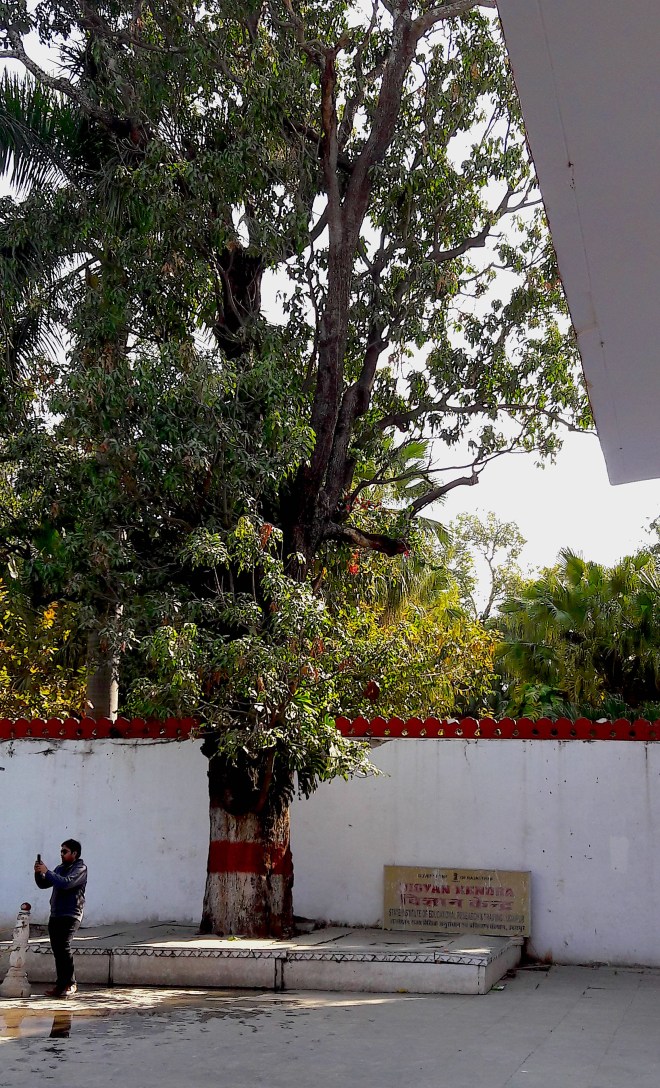 An impressive tree, I think, a mango tree perhaps. If so she would have been stoned, prodded and climbed all over the entire long summer. But undaunted, unconcerned she has continued her journey to reach for the sky.
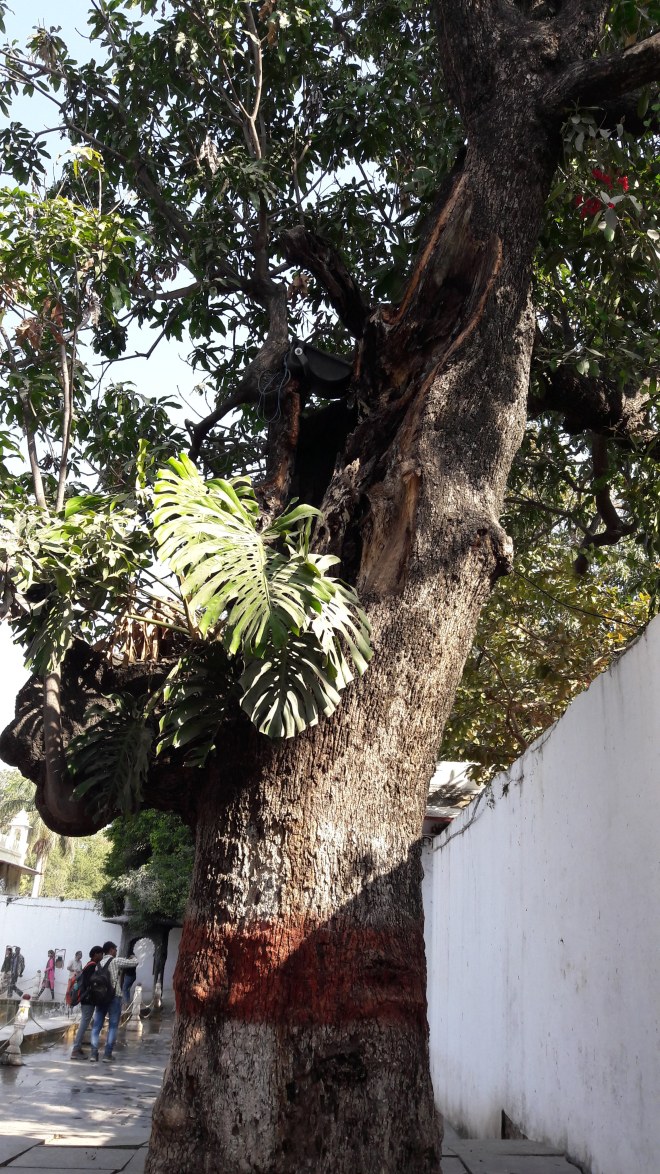 I come closer. She allows a money plant to drape her like a scarf, even allow a lamp to rest on her curves.
 Hey wait! That’s no drapery – it’s growing out of her. Just another surrogate mother for one who is not even her kind. My kind? she asks. What’s that? All life is my kind.
 Just look at those wounds and scars. Don’t they hurt? I ask. No she shakes her branches.
 Liar. I choke on tears as I walk over to the other side. Her silent howl of despair unheard in this vast preoccupied universe.



 Stories and more