G = Godh Bharai

The Godh Bharai ceremony or literally ‘the lap-filling’ ceremony maybe considered equivalent to the Western concept of a baby shower. The ceremony is typically held in the seventh and ninth month of pregnancy. Usually, the first one is hosted by the in-laws and the later one, by the girl’s parents. In both ceremonies, the mother-to-be is blessed by the elders, showered with gifts and fed with food of her choice. Men are generally excluded from this ceremony.

However, in certain regions of India, particularly North India, a Godh bharai ceremony is also held before the wedding. The ceremony, conducted by females from the groom’s family, symbolizes the official acceptance of the girl as the daughter of their family.
https://weddingcarnivals.files.wordpress.com/2014/08/asih-sister1.png
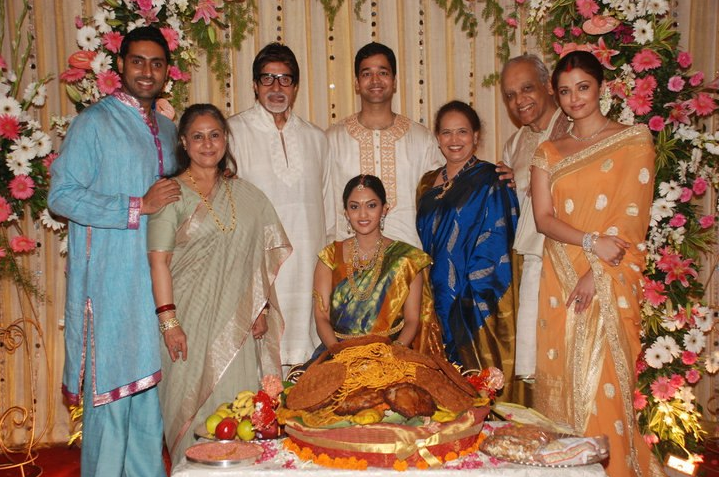
Rather ironic that I am able to recognize everyone other than the bride and the groom. Sad but true. Even the page on the internet has expired. Perhaps one of you could help? Pic link

The pic was just to up the glam quotient (for the uninitiated and interested – that’s Amitabh Bachchan second from the left with his wife and son and on the right is Aishwarya Rai Bachchan with her parents) and cover up the fact that I don’t know much about the custom. Not that I know much about Bengali weddings – like my professor would say, your English is worse than your Bengali, which you don’t know

Anyway to get back to the topic at hand, in this ritual (as gleaned from the internet and some hearsay evidence) the bride-to-be typically wears a sari and sits cross-legged on the floor with the free edge of her sari (pallu) held up above her lap (godh). The groom’s family brings gifts, jewellery, doll, make-up items, clothes and sweets, which are placed in the bride’s pallu. The doll symbolizes their wish and blessing that she bear many children in the future. The girl respectfully accepts all the gifts and takes the blessings of the elders by touching their feet.

Thought for the day: “The only gift I have to give, is the ability to receive. If giving is a gift, and it surely is, then my gift to you is to allow you to give to me.” ― Jarod Kintz

Hence, my gift to you is leave to leave me a note and on this note, I take your leave 😉


F = Fishy Business

While most regions of India shun non-vegetarian food during auspicious occasions such as weddings, Bengali weddings are incomplete (indeed unacceptable) without non-vegetarian food. Fish, in particular, is very close to the heart of the true Bengali. In fact, it is considered inauspicious for a married woman to refuse to partake fish. After the wedding, the bride and groom are served a lavish meal comprising of a numerous items including a variety of fish preparations.

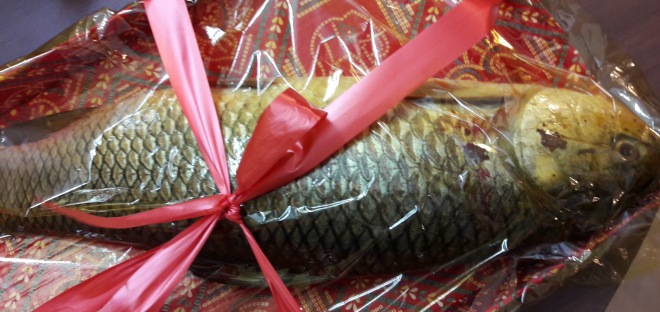
But what is perhaps most remarkable (and weird) is that before the wedding, along with clothes and other gifts that arrive from the groom’s family to the bride’s house, is a whole fish (usually Rohu or carp), decorated like a bride complete with vermilion and nose-ring!

image
Fishy gift

However, as now more and more intercultural marriages are happening, in case the bride’s family is not comfortable with such fishy practices, sweets in the shape of fish are considered an acceptable alternative.

Thought for the day: When you fish for love, bait with your heart, not your brain:- Mark Twain

And I too am fishing – for comments 😉
For more information about the blog please click here

E = Eye to Eye

In India, traditionally, weddings are ‘arranged’ by the families on the basis of ancestral history, social standing and astrological predictions. Often, the bride and the groom didn’t meet each other until the day of the wedding. In West Bengal, there is a special (and cute) ceremony for the bride and groom to ‘see’ each other for the first time known as Shubho drishti or literally ‘auspicious glance’.

This custom involves the resplendent bride being seated on a low wooden stool (pidi) and carried in by her brothers while she covers her face with betel leaves. The groom stands under the open sky while the brothers take the bride around the around the groom seven times (saatpaak) – binding her irrevocably to the groom.

Subsequently, the bride is turned to face the groom and is allowed to remove her ‘veil’ of leaves and they look at each other for the first time. There is a short story by Bonophul, that is worth a read.

Of course, in today’s time and era, this is not the ‘first’ time that the bride and groom ‘see’ each other. Nevertheless, the entire process, culminating in the meeting of eyes for the first time under public gaze (amongst hoots and catcalls) can still be a heart stopping exhilarating moment and remains one of my personal favorite memories.

Thought for the day: “As soon as I look up, his eyes click onto my face. The breath whooshes out of my body and everything freezes for a second, as though I’m looking at him through my camera lens, zoomed in all the way, the world pausing for that tiny span of time between the opening and closing of the shutter.” ― Lauren Oliver, Delirium

Thanks for reading and leaving me a note.

For more information about the blog please click here and for the readers of Moonshine, here’s Chapter 51. Please note that, there will be no update of Moonshine on Friday as I am traveling. But do drop in for challenge posts will be up as per schedule :)

D = Dhodhi Mongol

The custom of Dodhi Mongol or literally ‘curd auspicious’ is followed in West Bengal. On the day of the wedding, the bride is woken up before dawn for the ceremony. After the ritualistic bath, seven (or five, or three) married women slip on a pair of white (shaka) and red (pola) bangle on each hand of the bride. They also feed her a special dish of curd, rice, sweets after which she is not supposed to eat anything for until the wedding is over. Of course liquids, such as buttermilk, coconut water, are allowed.

I was told that custom was undertaken because curd has a cooling effect, which is useful for the usually nervous bride who would otherwise be likely to vomit or be nauseated. But in my case, I felt terribly sick because I was dying of hunger throughout the day 😀

To be fair, even the boy undergoes a similar fate – he is also not supposed to eat anything until the wedding is over. But then men usually do manage to sneak in something or the other – at least my groom did 😉

Even though I am not a fan or exponent, Hinduism strongly promotes and advocates fasting. Abstaining from food is not only believed to be good for the physical body and an essential aid to detoxification but is also believed to create alignment with the Absolute by establishing a harmonious relationship between the body and the soul. Much like meditation, fasting is believed to not only to promote and enhance inner focus but also bring discipline in one’s life. According to Hindu philosophy, food means gratification of the senses and to starve the senses is to elevate them to contemplation.

Hindus are known for their festivals and numerous gods and goddesses and the most common way to propitiate one’s personal favorite god is by fasting. There is a fast for each day of the week, every purnima (full moon) or ekadasi (11th day of a fortnight), navratri (a nine-day long festival that comes twice a year – many fast for all nine days) and the list goes on and on.

With so many fasts, a person may end up fasting on most days of the week. For instance, my mother, keeps a weekly Tuesday fast and a one day fast every navratri (sixth day) and another fast (neel puja) that occurs yearly (among many such) – it has happened that all have fallen one after another – so that means no (or little food) for three days in a row at 80 years of age! Luckily for her this year all three have fallen on Tuesday – though she isn’t quite convinced and is determined to check and double check the dates…

Fasting can mean different things for different people – from absolute abstinence (no food no water – many people do this on Shivratri for Lord Shiva or women on Karwa Chauth for the health of their husbands) to avoidance of salt and cereals (so only fruits and dairy products are consumed) and/or meal only once a day with liquids at other times of the day.

With so many fasting days, could one’s wedding (which is expected to occur once in a lifetime) be exempt? Hence the custom of dodhi mongol amongst Bengalis, but I am not sure about the custom in other parts of the country. How about sharing your knowledge and experiences on this – thanks for reading!

Thought for the day: A fast is better than a bad meal – An Irish proverb


C = Chura

Chura, a set of bangles, is usually a combination of white and red. The Punjabi and Sikh community mostly follows the custom of wearing chura. The bangles traditionally made of ivory with inlay work, used to encase the entire arm of the bride up to the elbow. She is expected to wear the bangles till up to a year of the wedding after which the bangles are taken off ceremoniously and replaced with glass bangles. However, nowadays, usually the husband is allowed to take off the chura after 40 days of the wedding. Traditionally, married women, regardless of roots, are not supposed to be bare armed or be without any ornaments of any sort.

The chura not only is an indicator that the girl is newly-wed but also is a deterrent to her immediately taking up heavy tasks in her new home – works as a sort of a ‘honeymoon’ period after which she has to shoulder most of the household tasks.

The churas come in various designs and and help a bride look gorgeous on her wedding day and most girls look forward to wearing them. But then like all things they come with their own baggage. Here is one such hilarious account from a frustrated bride which is worth a read.

Come on how about it – anything weird, funny, strange wedding customs that you would like to share? I would love to hear about it or indeed anything at all! Feel free to exercise your fingers 😉

Quote of the day:My dad used to say makeup was a shallow girl’s sport, but it’s not. It’s armor.”
Courtney Summers

Until tomorrow then. And oh for readers of Moonshine here’s Chapter 50 – hope you like! And just in case any of you is interested in grasping the essence of this blog, please click here

B = Boron

Boron refers to the welcome of the bride and the groom to each others house in Bengal. The groom’s welcome occurs before the wedding while the bride’s welcome occurs after the wedding. The customs and traditions associated with this welcome varies in different parts of the country.

In Bengali weddings, when the groom reaches the house of bride, the bride’s mother accords him a special welcome amidst conch shell blowing (by the way, just to set the record straight – that is not my picture in the previous post 😉 ) and ululations by the gathered married women folk.

For boron, the groom is felicitated by the bride’s mother in an elaborate ritual where  several items are kept on a bamboo winnow (kulo) like betel leaves, earthen lamp, dhruv (grass stem with three leaves) etc each of which has a symbolic meaning. In this ritual, winnow is touched to the groom’s forehead then to the ground and again to his forehead by the bride’s mother. As an elder, the gesture is part blessing, and part reverence, since the groom embodies Lord Vishnu’s  on the day of the wedding.

Boron customs vary even within Bengalis. As a 7 year old, I remember my aunt doing the boron of my cousin’s groom. One custom involved my aunt measuring the groom’s length with the aid of a reel of cotton. To my utter astonishment, my aunt then proceeded to swallow the entire length of the thread albeit after placing the rolled up ball in a portion of banana. Apparently, this custom symbolized the groom becoming a son to her. Interestingly, there doesn’t seem to be any such equivalent custom for the bride 😀

On the other hand, it’s the Gujarati grooms who have a rather uncomfortable welcome (known as the Ponkvu) at the bride’s home. After the traditional welcome (aarti) by the mother-in-law,  she playfully tries to grab his nose at the entrance. Apparently this is to remind the groom that he has come rubbing his nose at the girl’s door asking for her hand from her parents. Nowadays, not only the mother-in-law but any or all his in-laws (especially females) tend to have a go at the groom’s nose (and or of his friends!). As one can imagine this custom is involves a lot of fun and laughter and helps to break the nose, err I mean, the ice.

Ohh I could go on and on! But then I don’t want want to scare you off 😉 Have a great weekend and see you all on Monday.

Thanks for dropping by and do leave me a note 🙂
Quote for the day: “Enter freely and of your own free will!” Bram Stoker, Dracula
For more information about the blog please click here 


A = Alta

It’s finally here my first A to Z blogging challenge and I am super-excited! My theme for the challenge is Indian weddings and I request you all to join the celebrations 🙂 

ॐ श्री गणेशाय नमः

Ruma.jpg
Let the festivities begin

Alta, a red dye, is considered to be one of 16 elements of make up also known as solah shringar. It symbolizes fertility and prosperity and constitutes an essential component of the Bengali bride’s make up. Alta is used to adorn the hands and feet of the Bengali bride. In fact, all married women from West Bengal are expected to wear alta on the occasion of any religious festival or wedding. As a child, I remember my mother putting alta with the help of a swab of cotton wrapped around a thin stick before Durga Puja. We would watch fascinated (and clamor to be similarly treated) as she put her foot on a newspaper and brush the color around her feet. But she didn’t color her hands – instead she would put a dot on the base of her hand to complete the ritual.

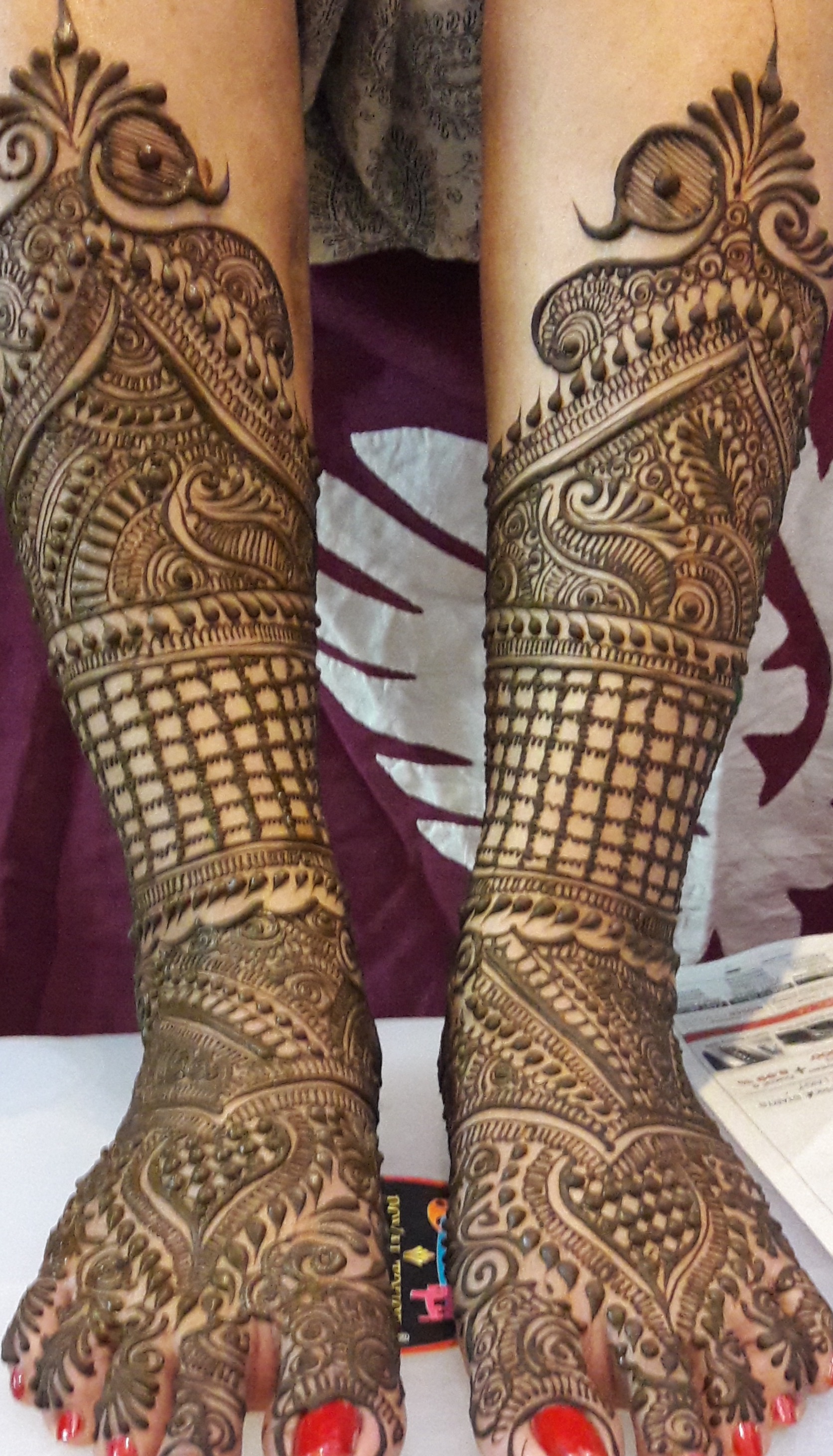
Traditionally made from betel leaves, alta is believed to have a cooling effect. Alta stains and dries quickly. Mehendi or paste prepared from henna leaves is the preferred decorating agent particularly in North India. But nowadays, brides from all parts of the country regardless of tradition prefer to decorate their arms and feet with mehendi in an elaborate custom.

Mehendi decoration of bride
Bridal mehendi

In some parts of India, before entering the house of her in-laws, the new bride steps into a plateful of alta and then walks ahead with her right foot first leaving imprints of her feet on the floor of her house. This symbolizes the entry of Devi Lakshmi, the Goddess of Wealth, into her new home along with the bride.

Thank you for visiting 🙂 See you tomorrow and dont forget to leave me a note 🙂

Quote for the day: What you’ll need most is courage. It is not an easy path that you’ve set your foot upon:- Larry Wall

For more information about the blog please click here and for the readers of Moonshine, here’s Chapter 49.

Marching On

Hello everyone! March is all but gone and April is upon us. Excitement has given way to the jitters. Just, in case it slipped your mind, one fine day, I lost my marbles (too much association with Biji eh Mymind?) and I signed up for the blogging challenge beginning this April!

As I mentioned my earlier post, the challenge is to blog every day in the month of April (except Sundays) using each letter of the alphabet on any topic – random or theme based. Wait there is more – there is a separate list for those who intend to have a theme based blog posts – I signed up for that as well! In addition, the participant has to read and comment other blogs as well – a great way of networking, finding friends and like-minded people in this vast alternate universe.

This weekend I spent most of my spare time checking out the participating blogs. What an eye opener that was. It was so exhilarating to find such a huge range of blogs with innovative and intriguing themes. I can’t wait to read them all – what? Oh darn it, did you have to remind me? Yes, yes of course err post as well.

Now that exams are over and you are all more relaxed and chilled out, I do hope you too will be able to spare some time for this blogfest? And while you go wandering all over the blogosphere, I hope you will drop in for a breather at Stories and more. 😉

Indian weddings is the theme for my blogging challenge and I do hope you will enjoy reading about some of the myriad customs and rituals that are part of the great Indian wedding. As an appetizer, here’s the link to some really strange wedding rituals from around the world.

So, come April, grab your cuppa tea, pull up your reading device and get ready to learn new words and new customs – just like I did. And oh yes before I forget, here’s Chapter 48 and more about this blog. How could I miss Calvin and Hobbes?

Calvin and Hobbes

By the way, Calvin and Hobbes don’t much care for weddings so they will be back only after the brouhaha is over and done with 😉

 Thought for the day

“The key to life is accepting challenges. Once someone stops doing this, he’s dead.”
Bette Davis

Now how about leaving me a note? At least wish me luck!

You are Invited!

Hello everyone – so good to see you here! I am terribly excited about the upcoming blogging challenge. As I mentioned in my previous Post, I signed up for the blogging challenge beginning next month. This is my first foray into the challenge, which has been running for the seven years now.

The challenge is to blog on every day of April (except Sundays) on any topic or a theme-based topic from A to Z. Taking the plunge, my initial reaction was to opt for a random write-as-you-go-approach but then a theme-based approach seemed more appealing. I juggled with several topics but then when I attended a great Indian wedding last week, every other topic faded to insignificance!

As per the rules, today is the A to Z Blogging Challenge -Theme Reveal day. So, hold your breaths – tantaraaaa –  here’s my theme for the 2016 A to Z Blogging Challenge – Indian weddings.

India is a huge country with myriad customs, rituals, traditions that stretch over days and vary not only from place to place but also family to family. And I have to confess, I have attended very few weddings. Actually mine was the only one I have sat through completely – though I did try to take notes on the last wedding.

I do hope that you will chip in with your variations, versions, comments, suggestions, and favorite customs. Mark the date on your calendars please – 1st of April 2016.

Nope it’s not an April Fool’s prank. Err well, you’ll never know for sure until you log in will you 😉

Now back to Rajani’s trials and tribulation as she journeys through her life – Chapter 46 and do check out the revised blog index entitled About this Blog.

But before then, a peak at the one and only one Calvin and Hobbes


Thought for the day: A wedding is an event, but marriage is a life:― Myles Munroe

As always, I look forward to hearing from you on anything and everything. Have a great day and a super week ahead.