P = Panigrahanam

Panigrahanam literally means, “accepting the hands” and is also called hastmilap (joining of hands). This ritual symbolizes that the groom takes the bride as his wife and undertakes responsibility for her future well being.

image
Panigrahanam

In this ritual, the groom takes the bride’s right hand in his right hand, while chanting the following mantra from the Rig Veda.

I take thy hand in mine, yearning for happiness
I ask thee, to live with me, as thy husband
Till both of us, with age, grow old

Know this, as I declare, that the Gods
Bhaga, Aryama, Savita and Purandhi, have bestowed thy person, upon me
that I may fulfill, my Dharmas of the householder, with thee

This I am, That art thou
The Sāman I, the Ŗc thou
The Heavens I, the Earth thou

The Gods mentioned above are: Bhaga signifying wealth, Aryama signifying heavens/milky way, Savita signifying radiance/new beginning, and Purandhi signifying wisdom.

It may be noted that there are four main goals in the life of a Hindu – Kama (love and physical pleasure), Artha (wealth and material goods), Dharma (righteousness) and Moksha  (the final release or liberation from the cycle of life, death and rebirth) – in increasing order of importance.

The first three goals are to be fulfilled through grihastashram or the householder’s life and for this a man needs the assistance of his bride and life partner.

Panigrahanam is believed to be of particular significance in Hindu weddings. This particular ritual usually takes place after kanyadaan i.e. after the parents hand over their daughter to the groom. The groom, in turn, accepts her and requests her support with above words of promise and reassurance.

Quote of the day: Don’t walk behind me; I may not lead. Don’t walk in front of me; I may not follow. Just walk beside me and be my friend.:- Albert Camus

Come on ladies and gentlemen – let the war of the worlds words begin 😉

O = Oonjal

Oonjal meaning ‘swing’ in Tamil is a custom unique to the Iyer subsect of Tamilian Brahmins. The bride and groom sit together on the oonjal, which is decorated with flowers and ornaments and rocked gently. As part of this custom, relatives and friends sing auspicious songs, bless them and feed them a mixture of milk, sugar and banana. Water and lit lamps are carried around the swing to keep away demons and ghosts. Elderly ladies throw red and yellow colored rice balls in all directions to ward off evil spirits.

The chains of the swing symbolize the karmic connection with the Almighty and the swinging motion is representative of the highs and lows of life. Through this custom, the couple is showered with blessings so that they are able to bear these ups and downs with equanimity and face the challenges ahead as a single unit and in a steadfast manner. The presence of friends and family members during this ritual signifies their support and help during the couples’ married life.

For more about Tamil Iyer weddings, please click here

Care to share the highs and lows of your special day? Okay I will go first – High was of course during the Eye to Eye ceremony and low was when the groom didnt turn up!

I mean he didn’t turn up on time – quite the same thing in my dictionary. Here I was, up since 4 am, all decked up from top to toe, caked with make-up, dying of hunger and he couldn’t even be bothered to turn up on time? Did he even want to get married to me? How dare he keep me waiting…ahh there he was – at that moment I could have cheerfully murdered him.

His excuse? Traffic jam.

Yeah right.

If there weren’t so many witnesses…

Quite an auspicious beginning wouldn’t you say? 😉

Quote of the day: The one who has been through the ups and downs and still with you is the one you can count on

For more information about the blog please click here and for the readers of Moonshine, here’s Chapter 55


N = Noa

Noa, or a bangle made of iron and gold, maybe considered the Bengali equivalent of the mangalsutra or the wedding ring. All married women are expected to wear this apart from the traditional white (shaka made of conch shells) and red (pola made of red coral) bangles. Seven married women slip these bangles on the bride’s hands on the morning of the wedding in an elaborate ceremony. Usually simple shaka pola are worn while gold work shaka pola are also available.

On the other hand (rather, for the left hand), the noa is gifted by the groom to his new bride upon her arrival at his home. In case the family is too poor to afford a gold bangle, the groom gifts an iron bangle to his bride. The noa is supposed to protect the bride from the evil eye and evil spirits. Like the mangalsutra, there are several exotic designs of the noa, with varying amounts of gold.

Most Bengali married women of today tend to forgo all symbols of the wedded status (yours truly included), yet they do continue to wear the noa. This is possibly because the noa looks like any other bangle and is available in several tempting unique and attractive designs!

Quote of the day: “Jewelry takes people’s minds off your wrinkles”― Sarah Phillips

So what do you think?

Wish you all a very happy and enjoyable weekend – will be back on Monday 🙂

PS: Interestingly, the word bangle originated from the Hindi word bangli or glass ring armlet and entered the English language between 1780-90.

PPS: For glimpses of exotic traditional Indian jewelry check out this site.

Edit: Just in case anybody is interested in knowing more about Bengali jewelry, please check out this site

M = Mangalsutra

That the English phrase ‘tie the knot’ means to get married is well known, yet its origin is less clear. A quick search showed that it’s not really known whether the expression derives from an actual knot used in marriage ceremonies or whether the knot is merely symbolic of a lasting unity

But in Hindu weddings, tying the knot appears to be integral to the wedding ceremony. The knot may be made between the robes of the bride and the groom. The knotted robes are to be kept tied for at least a year. In addition, in many regions of the country, this is also accompanied by the tying of a mangalsutra (literally holy thread) or thaali (as it is known in south India) by the groom around the bride’s neck. This necklace is usually made of gold and black beads. The groom ties it with the prayer -“May you live long by wearing this sacred mangalsutra, the reason of my life”. In some cultures, three knots are tied, first by the groom, and the other two by the sisters, symbolizing the bride’s union with her new family.

Most Hindu weddings have this custom of tying the holy thread around the bride’s neck – in fact, even Syrian Christians of Kerala also wear a thaali (with a cross at the center) besides the wedding ring. There are several variations in the thaali and one can even identify the ethnic background of the bride from the designs – more about this here.

Much like the wedding ring, the mangalsutra may be used to identify the marital status of a female. Many ethnic groups also wear toe-rings as a symbol of their marital status. But considering the diversity of India (and progressive stance), its absence does not necessarily indicate she is unmarried. For instance, Kashmiri Pandits (wear dijaru an ear ornament) and Bengalis (next on the list!) do not have this custom.

But, of course, the men are not required to sport any symbol of marriage – not even a wedding ring. 😉

But to be fair and contrary to popular belief and the importance given to this custom  – this is not a religious practice but a social one, and that too of recent origin. Let’s face it, women (well most women, have to admit am not much of a jewelry person) like to wear jewelry. And all that associated superstition probably evolved over the years to enable the daughter-in-law to hang on to her only piece of jewelry in times of financial crises. Moreover, in the absence of bank lockers and stuff, where else to keep it safely but on her own person? Do correct me if, as usual, my imagination is running wild…

Quote for the day: When you reach the end of your rope, tie a knot in it and hang on :- F.D. Roosevelt

Let me know what you think – pretty please? 🙂

For more information about the blog please click here and for the readers of Moonshine, here’s Chapter 54

L = Lavish Spread

Food constitutes an important (and for many guests the only worthwhile) aspect of wedding celebrations – especially Bengali weddings. Often the success of a wedding is judged by the quality and variety of items served. I have often heard friends and relatives urge parents to get their children married off for no other reason than their desire to indulge in some good old fancy ‘wedding’ food!

The way to an Indian heart is definitely through food. But to be fair, we do love to feed others too. Till now, even a casual visitor to any home is rarely sent away without something to eat. And both are considered a slight – not to serve food as well as refusal to eat.

Earlier, food for all the days of the wedding festivities was prepared at home by the ladies of the house.  Sweets were made by hired professionals (vien) installed at the house. Guests usually sat cross legged on the floor (later upgraded to tables) in long rows with plantain leaves in front of them. A stream of volunteers, usually young boys of relatives and neighbors, helped serve the numerous lip-smacking delicacies of the day. But nowadays, the catering services industry has more or less taken over the whole initiative and the traditional style has given way to the western buffet, at least in most of the metros and big cities.

However, once the wedding ceremony is over, the close family members of the bride and groom still sit down for their first traditional meal together.

Apart from the main course, which may offer any number of mouthwatering dishes (I once counted 30 main course items at a wedding), there are an array of starters and snacks to tease and appease the attending guests. These may be served by mobile waiters at the venue or be available at stalls very much like that in a market. The dessert section with its multiple offerings is the final icing on the cake (and needless to say most fattening and irresistible).


Most Hindu weddings shun non-vegetarian food during the auspicious occasions such as weddings. However, on the other hand, as mentioned earlier, a Bengali wedding is considered incomplete (and quite unacceptable!) without an array of the choicest non-vegetarian delicacies, particularly fish.

At the dinner, hosted by my in-laws for my wedding reception, had no vegetarian dish (apart from the dessert, of course) – nope not even the rice. There was quite a bit of a flutter when my in-laws came to know that among the guests were a couple (close family friends from my side) who were pure vegetarians!

By the way, today is the Bengali New Year – as you can see, all we can think of is food 😉

Image source

Bon appetit! Err not too much for me – I am on a diet 😀 But I do hope there is feast for my eyes in the comment section 😉

Wish you all a very Shubho Nobo Borsho (auspicious New Year), Kerala Hindu New Year (Happy Vishu) and Assamese New Year (Happy Bihu).


Quote of the day: “After a good dinner one can forgive anybody, even one’s own relations.”
Oscar Wilde

K = Kanyadaan

Amongst Hindus, kanyadaan is considered to be one of the most pious acts. Kanyadaan enables the parents to wash away all sins, including those of their previous births.

Before the knot is tied, there is a formal and poignant ceremony wherein the father of the bride literally ‘gives away’ (daan) his girl (kanya) to the groom, hence kanyadaan. In this ritual, the father puts his daughter’s right hand is put into the groom’s right hand (Hastamelap, which means joining of hands) while reciting sacred verses. The bride’s mother pours holy water on bride’s father’s  palms, which flows into groom’s and then into bride’s palms, symbolizing the  continuity of life, repaying the debt to their forefathers and  the passing of the family heritage to the next generation.

image

Today, many consider this ritual to be sexist and objectionable. Frankly, I did too. But one must understand that these rituals are being carried out in accordance to the rituals set in the Vedic period ( c. 1500 – c. 500 BCE) when the Vedas or the holy scriptures of Hindus were composed. Since then, thousands of years have passed and there are various interpretations of the texts. Moreover, the sentiments behind many of these customs have been lost, misinterpreted or reinterpreted with modern sensibilities.

In a way, this may be considered a classic case of ‘actions speak louder than words’. The symbolic act of ‘giving away’ of the daughter is highlighted while the conditions laid down by the bride’s father and the groom’s subsequent acceptance and vow (chanting the sacred verses) are ignored (or conveniently forgotten). More often than not, neither the bride nor the groom are aware of what exactly they are promising as Sanskrit, the language of the sacred texts, is not understood by most. It is heartening to see however, that today, in many weddings, the presiding pundit takes pains to explain the meanings of the vows being taken.

On the day of the wedding, the groom is considered to be Lord Vishnu to whom the bride’s father entrusts his daughter with the following chant: ‘I am giving away this beautiful daughter of mine adorned with gold ornaments to you considering you as Lord Vishnu, with the hope of attaining Brahma’s region. I am giving away this daughter to you for the upliftment of my ancestors with The Omnipresent Lord, all elements and deities as witnesses’.

The groom should say, ‘I accept this girl for the fulfillment of dharma (righteousness), and for acquiring progeny’. The bride’s father gives away his daughter with the condition that he should ‘not violate the regulations with regard to dharma, wealth (artha), desire (kama) pertaining to her’. In accordance, the groom vows ‘not to violate the regulations – but more on this later.

Rather than focus on the act of kanyadaan (and denounce it), it would perhaps be more appropriate to revive and stress the sentiments and intentions behind the ritual.

Quote of the day: “A gift consists not in what is done or given, but in the intention of the giver or doer.” ― Seneca

Look forward to your opinions and reactions 🙂

For more information about the blog please click here and for the readers of Moonshine, here’s Chapter 53.

J = Jaimala

Jaimala refers to the ritual of garland exchange between the bride and the groom and is usually the first ritual of the wedding. On the day of the wedding, this is the first time the bride and groom come face to face and thereafter, all rituals are done together as a unit.This custom may also be taken as a symbolic acceptance of the other as the life partner. Many weddings have elaborate jaimala functions, such as one showed here.

In Bengali weddings, this particular custom is a bit more elaborate and complicated. The bride sits on a low wooden stool (pidi) hiding her face behind betel leaves as described earlier wherein she is taken around the groom seven times before exchanging the first glance with him. After all this, comes the Mala bodol or literally ‘garland exchange’.

This garlanding of each other happens thrice, at least one of which is crisscrossed – that is garlanding the groom through the circle of his arms while he does so while encircling her arms. Of course, again amidst much cheering and gaiety. I am not quite sure if this has any religious symbolism or it is just to tease the bride and groom not to mention the brothers who, by the way, are still holding the bride up on the pidi while the groom is egged on by his friends and family to avoid the noose! It’s quite a fun-filled chaotic moment – one where I almost fell off the pidi. I remember scrabbling and scrambling for balance. Come to think of it, I still am! 😀

Quote for the day: I love being married. It’s so great to find that one special person you want to annoy for the rest of your life. Rita Rudner

Hoping that you will leave me note…

Thanks for reading 🙂

I = Invitation Cards

Wedding invitations of today perfectly blend tradition with modern sensibilities. The invitation cards (as well as the envelopes) usually carry one or more religious symbols such as of: Lord Ganesha or the one who removes all hurdles; the kalash or earthen pot with mango leaves signifying bliss, abundance and joy; the symbol of Aum or Om – the universal symbol of Hinduism represents peace and harmony. Inside the card, designs are often modern and trendy – like the one above.

Before being distributed, each card is adorned with the auspicious red and yellow rice color. The first card is usually offered to Lord Ganesha for his blessings. The image here is taken from the envelope of wedding card – the sketch on the left is of Lord Ganesha, the elephant headed God, the remover of obstacles. Please also note the red and yellow dots on the right.

In India, invitation cards are usually in the local language. However, in big cities, they are bilingual – that is, details are provided in both English and the mother tongue. In fact, we had two separate sets of cards – one in Bengali and one in English. Moreover, the invitation traditionally goes out  in the name of the grandparents or at the very least the parents. More often than not, ancestral details and antecedent details are also included. Formal wording and typo errors are the cause of many a sleepless night for the beleaguered parents. There are no dearth of nitpicking guests who take particular pleasure in calling up to point them out, with unconcealed glee and a touch of (oh heck who am I kidding – dollops of) grating superiority.

Earlier, wedding invitations were delivered personally and even now, the custom is expected to be followed. In West Bengal, posted invitation cards contain a formal apology for breaking tradition and sending a postal invite. For those who reside in the same city, it is expected that parents will personally deliver the wedding invitation. Otherwise it is likely that the concerned individual may consider it a slight and not turn up for the wedding – worse turn up and throw a fit! 😉

However, time (and traffic constraints) have eased these expectations and invitees (at least the younger generation) are considerate enough to to settle for a postal invite. Provided, it is duly followed up by telephonic exhortations to come and bless the happy couple and participate in the festivities and feasting. Many sections of the Indian community (especially those who can afford it) not only come personally to deliver the card but also shower invitees with sweets and other gifts, especially when it is the wedding of their son as a token of their happiness at the upcoming nuptials.

Quote for the day: “I didn’t want to go, but that doesn’t mean I didn’t want to be invited.”
Jarod Kintz

Would love to know about your invitation customs (and goof ups!)

Have a great week ahead and happy blogging while I catch up on my reading 🙂 For the readers of Moonshine here is  Chapter 52

H = Haldi Ceremony

This ceremony is quite common amongst weddings across the country and is known by various names in different regions of the country ubtan, mandha, tel baan, gaye holud etc. Haldi or turmeric plays an integral role in Hindu (and even Muslim) weddings. The yellow color is considered to be auspicious and is also believed to ward off evil spirits. But my suspicion is that turmeric is so popular because it acts as an exfoliant astringent, body cleanser and skin tightener, which adds glow to the skin and helps bring a glow to the bride and groom. Haldi also has antiseptic properties. In fact, in earlier times, the prospective bride and groom used to be scrubbed daily with this paste beginning a month before the wedding. However, nowadays the haldi ceremony is done just a few days before the wedding, or even on the morning of the wedding.

The haldi paste is made from turmeric, rose water, and sandalwood powder. It also signifies purification of body and soul in preparation for entry into holy matrimony.  After the haldi ceremony the bride and groom cannot see each other until the wedding nor leave the house. In this ceremony, family members (again mostly females women) apply haldi paste to the bride and groom (at their respective residences).

In West Bengal, haldi for this ceremony comes from the groom’s side. The paste is the same one that has been used for the groom and signifies unity of groom and bride. The arrival of the haldi paste at the bride’s home (along with other gifts) is a much awaited event and is greeted with conch blowing and ululation.

While the haldi is supposed to be smeared all over the body, it is symbolically put on five places: the feet, knees, arms, hands and face; three times or seven times using a brush of grass. Often the bride and the groom also share a part of the sacred paste with their unmarried friends and siblings believing that this will enable them as well to soon find a partner – that too a good looking partner.

This ceremony is usually accompanied by singing of folk songs much merriment, fun, shrieks and screams of laughter. It is a messy (and smelly) affair with it becoming a free for all but nevertheless so much fun!

Oh yes, dont worry – the bride and the groom are allowed to scrub off the paste after a public drenching, err ritual bath – see below 😉

Quote for the day: I am a great believer in that if you take good care of your skin you wont need a lot of make up – Demi Moore

Have a great weekend people and see you all on Monday. Look forward to reading your thoughts and thank you for leaving me a note 🙂

G = Godh Bharai

The Godh Bharai ceremony or literally ‘the lap-filling’ ceremony maybe considered equivalent to the Western concept of a baby shower. The ceremony is typically held in the seventh and ninth month of pregnancy. Usually, the first one is hosted by the in-laws and the later one, by the girl’s parents. In both ceremonies, the mother-to-be is blessed by the elders, showered with gifts and fed with food of her choice. Men are generally excluded from this ceremony.

However, in certain regions of India, particularly North India, a Godh bharai ceremony is also held before the wedding. The ceremony, conducted by females from the groom’s family, symbolizes the official acceptance of the girl as the daughter of their family.

https://weddingcarnivals.files.wordpress.com/2014/08/asih-sister1.png
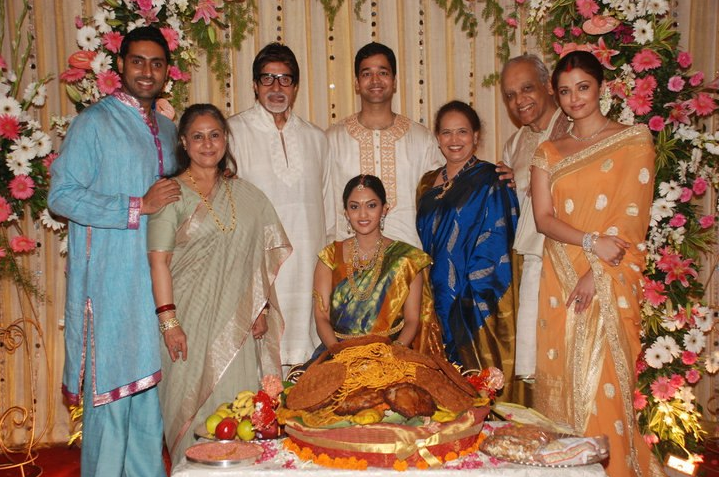
Rather ironic that I am able to recognize everyone other than the bride and the groom. Sad but true. Even the page on the internet has expired. Perhaps one of you could help? Pic link

The pic was just to up the glam quotient (for the uninitiated and interested – that’s Amitabh Bachchan second from the left with his wife and son and on the right is Aishwarya Rai Bachchan with her parents) and cover up the fact that I don’t know much about the custom. Not that I know much about Bengali weddings – like my professor would say, your English is worse than your Bengali, which you don’t know

Anyway to get back to the topic at hand, in this ritual (as gleaned from the internet and some hearsay evidence) the bride-to-be typically wears a sari and sits cross-legged on the floor with the free edge of her sari (pallu) held up above her lap (godh). The groom’s family brings gifts, jewellery, doll, make-up items, clothes and sweets, which are placed in the bride’s pallu. The doll symbolizes their wish and blessing that she bear many children in the future. The girl respectfully accepts all the gifts and takes the blessings of the elders by touching their feet.

Thought for the day: “The only gift I have to give, is the ability to receive. If giving is a gift, and it surely is, then my gift to you is to allow you to give to me.” ― Jarod Kintz

Hence, my gift to you is leave to leave me a note and on this note, I take your leave 😉