U = Uludhvani

A very peculiar and unique feature of Bengali weddings is the blowing of conch shells and ululation by the women during most of the ceremonies.

Ululation or ululudhvani as it known as literally means ‘ululu sound’. In this custom, women roll their tongues and produce a long, wavering, high-pitched vocal sound that is accompanied with a rapid sideways movement of the tongue. Ululation is an integral part of weddings, indeed all festivities. The ululudhvani along with the blowing of conch shells helps to ward off the evil spirits and bring in positive energies. It also serves to alert the other members of the household that some important event is ongoing and enables them to rush to the site of activity for timely participation.

In fact ululudhvani is also used as a communication code. In earlier days, when were large and all lived together in a big house, when a child was born (or news arrived) , three ululus signified a girl and 5 a boy. Quite useful and innovative dont you think – very much like posting on Facebook! No need to go around knocking on each door or listen to complaints about why didnt you tell me first or even better, use it to crow over another without being accused of doing so 😀

That reminds me of a joke:- Once two brothers split and stopped talking to each other. Time passed and the elder brother’s son died. As per custom, he invited all the villagers for the Shradh ceremony (ritualistic customs held typically 13 days after death where the invited guests are also served a meal) except his younger brother. He was furious and vowed vengeance. “When my son dies, even I won’t invite him for the Shradh.

In Kerala as well, ululation, called kurava, is an essential accompaniment in all ceremonial occasions. Ululation is present in other parts of the country as well. Odias call it Hulahuli; Assamese call it uruli. In Tamil it is known as kulavai.

Quote of the day: “We are all a little weird and life’s a little weird, and when we find someone whose weirdness is compatible with ours, we join up with them and fall in mutual weirdness and call it love.” -Robert Fulghum

Well what about it – got anything to say, add or comment? I am waiting….

For links to the other A to Z challenge posts, click here

T = Tatwo

In Bengalis, there is a unique custom of exchanging gifts or tatwo, between the groom’s and the bride’s families. Tatwo comprises of various articles of clothing, cosmetics, jewelry accessories and sweets for the bride and groom as well as their family members. Tatwo arrives from the groom’s side to the bride’s house on the morning of the wedding along with the turmeric paste for the haldi ceremony. Tatwo from the groom’s side includes saris (and other accessories) for the bride along with gifts for her close relatives (mostly saris), sweets, mishti doi (sweet curd) and  a whole fish  😉 Tatwo from the bride’s family is sent to the groom’s house on the day of her bou-bhat or wedding reception.

The beauty and uniqueness of this custom is in the way the gifts are presented. Each of the gifts are artistically decorated and presented on trays and wrapped in cellophane paper and put up for display. These days, professionals are available to prepare the tatwo but usually it is the members of the family who chip in with their creative skills and vie with the other side to show off their skill sets and artistic talents. Even sweets are not spared – although these are professionally done. Since I am a non-resident Bengali, I came to know about the custom only at my wedding (and of my kid sister’s talents in this direction). And it is only last month that I had the opportunity to be involved in the preparation of the tatwo. Beginning over two months before the wedding we would get together on weekends and sit surrounded by trays, saris, shirts, chart paper, paint scissors, ribbons, cellophane sheets, muscle cramps, chatter, laughter and a whole lot of fun. Again most of the credit goes to the bride’s tireless creative sister, but surprisingly (for me) even I managed to come up with some pretty nifty ideas (like the theme for this challenge and dont miss the Spiderman 😉 ). Each item is numbered and decoded in another cute little item called the suchipatra or catalogue. This ensures that each gift reaches the right person.


As one can imagine, transportation of these items can be a bit tricky especially if over long distances. Hence the peacock drooped a bit after his travel from Delhi to Kolkata (and beyond) and the (sari) boat (along with boatman) were forcibly squashed and made two dimensional.

To make matters more interesting (apart from the suchipatra) each of the clothing articles of the tatwo was presented with a couplet in Bengali. The  groom’s side had to deduce from couplet to whom it referred and only then claim the gift associated with it. My husband rose beautifully to the challenge but the best was when he got an SOS from about 1500 km – the couplet for the sister-in-law is missing!  He had about 10 min to come up with one – a whole lot of excitement, fun and bonding 🙂

Quote of the day: “Who, being loved, is poor?” -Oscar Wilde

Well, what did you think – dont keep it in, let us know 🙂 Have great weekend.

S = Saptapadi

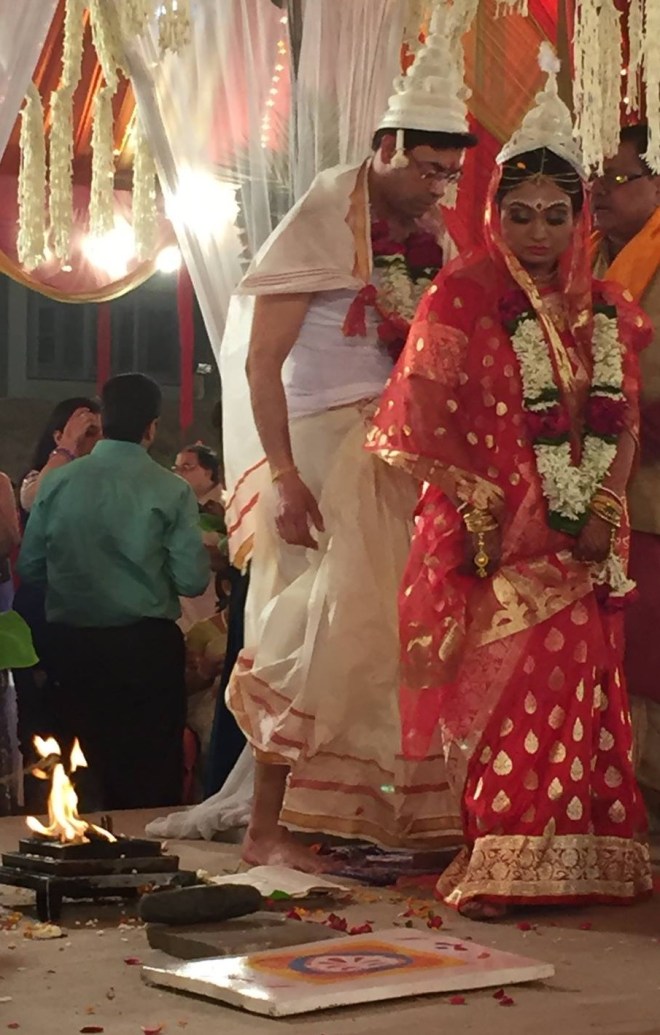
Saptapadi (or seven steps/feet) is one of the most important rituals and is of immense significance in most Hindu marriages. The saptapadi is the rite of seven steps taken together by the bride and the bridegroom, at a slow and measured pace side-by-side and step-by step in the northeastern direction. While moving forward the bride is always on the right side so that the bridegroom’s right hand is on her right shoulder. With each step, the bride and the bridegroom take a pledge together.

In saptapadi, (the customs for these steps vary with the groom leading his bride by holding her by the toe or the bride pushing a grinding stone on to 7 betel leaves/nuts) with each step the groom says:

O dear, I ask you to put your first step to make you the mistress of food grains etc in my house

O dear I ask you to put your second step so that you may become strong and powerful

O dear I ask you to put your third step so that you many earn fame and wealth in life

O dear I ask you to put our third step so that you may have the pleasures and facilities in life

O dear I ask you to put your fifth step for the growth of wealth in the form of cows

O dear I ask you to put your sixth step so that you may enjoy health and happiness during all the six seasons

O dear I ask you to put your seventh step so that you may enjoy all the seven pleasures of the world and always remain devoted to your husband like Jaanki.

In the saptapadi that the couple take together, each step is supposed to lead the bride away from her own family and with the seventh step she becomes an integral part of her husband’s family.

Different regions have their own variations and rituals and it can consist of only seven steps taken together by the couple along with the chanting of mantras. Or it may involve the bride and groom going around the consecrated fire seven times (or the saat pheras), reciting specific vows with each parikrama or round.

Vows made in the presence of the fire are considered unbreakable. Agnideva or the Fire god is believed to both witness and bless the couple’s union. Before circuiting around the holy fire, the robes of the bride and the groom are usually tied into a knot. They may or may not hold hands while circuiting and either one may lead the circuits around the consecrated fire. Pheras or circuits around the fire may number four, three or seven circuits round the sacred fire. Usually four circuits are led by the groom and the remaining three by the bride. However, again, this varies from place to place.
image

There are certain promises that the groom and the bride make to themselves and to each other, as they unite in the holy matrimony. These vows are taken during the pheras as the Vedic mantras are recited.

The Seven Vows are in Sanskrit  (with translation as interpreted from the ancient Vedic texts):

Phera 1: Blessing for nourishing food and noble and respectful life.

Groom’s vow: Om esha ekapadi bhava iti prathaman (I will love, cherish and provide for you and our children. You will support me and offer me food)

Bride’s vow: Dhanam dhanyam pade vadet (I will honor you. I take upon myself the responsibilities of the house and children).

Phera 2: Pray for strength (physical and mental). Also pray for a peaceful and healthy life

Groom’s vow: Om oorje jara dastayaha (I promise to support you forever. Together we will defend our family and home)

Bride’s vow: Kutumburn rakshayishyammi sa aravindharam (I promise to stand side by side with you in protecting our family and home)

Phera 3: Pray for prosperity and wisdom. Also pray for religious and spiritual strength and reaffirm their commitment to each other.

Groom’s vow: Om rayas Santu joradastayaha (I promise to work for the prosperity of this family. I also promise to be faithful to you and lead a spiritual life)

Bride’s vow: Tava bhakti as vadedvachacha (I promise to be faithful to you and to support you)

PHERA 4: Pray for the happiness of the couple

Groom’s vow: Om mayo bhavyas jaradastaya ha (I am fortunate to have you as my wife. I pray for a happy life and good children)

Bride’s vow: Lalayami cha pade vadet. (I will do my best to please you)

PHERA 5: Pray for happy children and happiness for all beings

Groom’s vow: Om prajabhyaha Santu jaradastayaha (I pray for the happiness and well being of our family. May we have righteous and obedient children)

Bride’s vow: Arte arba sapade vadet (I will trust and honor you. I will be with you always)

PHERA 6: Pray that we live in perfect harmony. May we have a long and happy life

Groom’s vow: (Oops – original missing! Anyone know it?) May we be happy together forever.

Bride’s vow: Yajne home shashthe vacho vadet (I will always be by your side in your endeavors)

 PHERA 7: May we always be good friends

Groom’s vow: Om sakhi jaradastayahga. (With this last phera we forever belong to each other)

Bride’s vow: Attramshe sakshino vadet pade.(I am delighted to be your wife. May we be together forever)

According to prominent Hindu texts, a marriage has no strength or recognition if this rite is not duly performed. Until the bride has performed the saptapadi she is considered unmarried. As per the tradition, initially the bride sits to the right of the groom and once saptapadi is solemnized, she is seated to the left of the groom, closer to his heart.

Note: The number 7 has an important significance in Hindu culture. For more information on this, click here.

Quote of the day: “Love doesn’t sit there like a stone, it has to be made, like bread; remade all of the time, made new.” -Ursula K. Le Guin

Thanks for reading and commenting 🙂

R = Reception

Alphabetical constraints have forced me to skip a few important and crucial wedding rituals but we will come to them in due course of the challenge 😉

For now, let us talk of the gala reception that is hosted by the groom’s family after the wedding is over. The primary aim is to formally introduce the new bride to their family and friends and also take their blessings before they begin their journey together.  On the day the new bride comes to her in-laws home (and her new home), usually that very evening or the next evening, a reception party is hosted by the groom’s side.  Understandably most of the invitees are friends and relatives of the groom’s side, however, relatives and friends of the bride are also invited to the function.

But before the public event, there are also certain functions and rituals that are undertaken at home as well. For instance, the bride cooks and serves her first meal at her new home. Nowadays this is more of a cursory ritual whereby the bride stirs a pot of kheer (a sweet dish made of milk, sugar and rice) and serves it to her new family.

In Bengalis, this custom is known as Bou-bhaat or literally ‘bride-rice’. In fact, even the evening reception is called as Bou-bhaat. As part of the rituals to welcome the bride to her new home, there is one which includes the groom. In the presence of his close family members, he formally offers her a plate of food and a new saree. He is also required to make a formal public declaration that from this day onwards he promises to take the responsibility of feeding and clothing her.

Many girls of today (well me too!) object to this custom, as they are financially independent and fully capable of self-sustenance. But it must be kept it mind that these customs originated thousands of years ago and in those days such a promise was a much needed reassurance and a source of great support to the girl so far away from her family? But perhaps it can be done away with now.

Wait…what’s the rush? Let’s think this through properly. For those not so ready to take offense, this can be a very entertaining custom. It does much to break the ice and help the bride gel with her new family. The groom is too embarrassed to formally utter the words (well mine was), which invites a lot of hilarity followed by demands of acceptance of greater responsibilities. For instance why take responsibility of just food and clothing, take responsibility for her cosmetics, her jewelry, her outings, her whims her fancies, so on and so forth.

As for me, I only regret that it took me so many years to take his word for it and go for it -I finally dumped everything and took up blogging full time. And boy, am I having a blast tapping away while he toils away 😀

So I for one, am all for tweaking this custom – apart from food and clothing let’s just add two more  to that list – a laptop and an uninterrupted wifi connection. 😉

So, what do you think 🙂

Quote of the day: Yesterday I was clever, so I wanted to change the world. Today I am wise, so I am changing myself – Rumi.

For all A to Z challenge posts, click here


Q = Qubool Hai

After Hindus, Muslims form the second largest religious community in India. Popular Hindi movies and television serials have done much to familiarize the general public with the Arabic words qubool hai, which literally means ‘I accept’ and is often used to symbolically depict a Muslim wedding. However, there are  of course, many other rituals and customs associated with Muslim weddings.

The wedding celebrations and functions begin with the Mangni or engagement of the couple. The Manjha ceremony, which involves the application of turmeric paste, is similar to the Haldi ceremony of the Hindus. This is followed by the Mehendi ceremony amidst much singing and dancing.

A qazi or religious attorney, sanctifies the wedding ceremony or the Nikaah. Broadly speaking and as gleaned from the internet, Muslim weddings involves the signing of a marriage contract, which includes the Mehr a formal statement specifying the monetary amount the groom will give the bride. The meher is considered the bride’s security and guarantee of freedom within the marriage. The amount is usually decided upon by mutual consent between the bride and the groom’s family members. The marriage is solemnized in front of at least two witnesses from both sides, stating the details of the meher.

The free will and consent of both the bride and groom is taken individually by the presiding qazi asking three times ‘qubool hai?’ The wedding will proceed further only after each of them individually reiterates ‘qubool hai’. Then the couple and two male witnesses sign the contract, making the marriage legal according to civil and religious law.

This may be followed by an additional religious ceremony, which usually includes a recitation of the Fatihah — the first chapter of the Quran — and durud (blessings). The nikah is followed by the wedding feast or the walima which means to ‘assemble or gather’. The timing of the walima varies by culture and opinion.

Any comments, additions, suggestions? Would  love to hear from you – especially someone who has been there done that 🙂

Quote of the day: You give but little when you give of your possessions.
It is when you give of yourself that you truly give.” ― Kahlil Gibran, The Prophet

For more information about the blog please click here and for the readers of Moonshine, here’s
Chapter 56


P = Panigrahanam

Panigrahanam literally means, “accepting the hands” and is also called hastmilap (joining of hands). This ritual symbolizes that the groom takes the bride as his wife and undertakes responsibility for her future well being.

image
Panigrahanam

In this ritual, the groom takes the bride’s right hand in his right hand, while chanting the following mantra from the Rig Veda.

I take thy hand in mine, yearning for happiness
I ask thee, to live with me, as thy husband
Till both of us, with age, grow old

Know this, as I declare, that the Gods
Bhaga, Aryama, Savita and Purandhi, have bestowed thy person, upon me
that I may fulfill, my Dharmas of the householder, with thee

This I am, That art thou
The Sāman I, the Ŗc thou
The Heavens I, the Earth thou

The Gods mentioned above are: Bhaga signifying wealth, Aryama signifying heavens/milky way, Savita signifying radiance/new beginning, and Purandhi signifying wisdom.

It may be noted that there are four main goals in the life of a Hindu – Kama (love and physical pleasure), Artha (wealth and material goods), Dharma (righteousness) and Moksha  (the final release or liberation from the cycle of life, death and rebirth) – in increasing order of importance.

The first three goals are to be fulfilled through grihastashram or the householder’s life and for this a man needs the assistance of his bride and life partner.

Panigrahanam is believed to be of particular significance in Hindu weddings. This particular ritual usually takes place after kanyadaan i.e. after the parents hand over their daughter to the groom. The groom, in turn, accepts her and requests her support with above words of promise and reassurance.

Quote of the day: Don’t walk behind me; I may not lead. Don’t walk in front of me; I may not follow. Just walk beside me and be my friend.:- Albert Camus

Come on ladies and gentlemen – let the war of the worlds words begin 😉

O = Oonjal

Oonjal meaning ‘swing’ in Tamil is a custom unique to the Iyer subsect of Tamilian Brahmins. The bride and groom sit together on the oonjal, which is decorated with flowers and ornaments and rocked gently. As part of this custom, relatives and friends sing auspicious songs, bless them and feed them a mixture of milk, sugar and banana. Water and lit lamps are carried around the swing to keep away demons and ghosts. Elderly ladies throw red and yellow colored rice balls in all directions to ward off evil spirits.

The chains of the swing symbolize the karmic connection with the Almighty and the swinging motion is representative of the highs and lows of life. Through this custom, the couple is showered with blessings so that they are able to bear these ups and downs with equanimity and face the challenges ahead as a single unit and in a steadfast manner. The presence of friends and family members during this ritual signifies their support and help during the couples’ married life.

For more about Tamil Iyer weddings, please click here

Care to share the highs and lows of your special day? Okay I will go first – High was of course during the Eye to Eye ceremony and low was when the groom didnt turn up!

I mean he didn’t turn up on time – quite the same thing in my dictionary. Here I was, up since 4 am, all decked up from top to toe, caked with make-up, dying of hunger and he couldn’t even be bothered to turn up on time? Did he even want to get married to me? How dare he keep me waiting…ahh there he was – at that moment I could have cheerfully murdered him.

His excuse? Traffic jam.

Yeah right.

If there weren’t so many witnesses…

Quite an auspicious beginning wouldn’t you say? 😉

Quote of the day: The one who has been through the ups and downs and still with you is the one you can count on

For more information about the blog please click here and for the readers of Moonshine, here’s Chapter 55


N = Noa

Noa, or a bangle made of iron and gold, maybe considered the Bengali equivalent of the mangalsutra or the wedding ring. All married women are expected to wear this apart from the traditional white (shaka made of conch shells) and red (pola made of red coral) bangles. Seven married women slip these bangles on the bride’s hands on the morning of the wedding in an elaborate ceremony. Usually simple shaka pola are worn while gold work shaka pola are also available.

On the other hand (rather, for the left hand), the noa is gifted by the groom to his new bride upon her arrival at his home. In case the family is too poor to afford a gold bangle, the groom gifts an iron bangle to his bride. The noa is supposed to protect the bride from the evil eye and evil spirits. Like the mangalsutra, there are several exotic designs of the noa, with varying amounts of gold.

Most Bengali married women of today tend to forgo all symbols of the wedded status (yours truly included), yet they do continue to wear the noa. This is possibly because the noa looks like any other bangle and is available in several tempting unique and attractive designs!

Quote of the day: “Jewelry takes people’s minds off your wrinkles”― Sarah Phillips

So what do you think?

Wish you all a very happy and enjoyable weekend – will be back on Monday 🙂

PS: Interestingly, the word bangle originated from the Hindi word bangli or glass ring armlet and entered the English language between 1780-90.

PPS: For glimpses of exotic traditional Indian jewelry check out this site.

Edit: Just in case anybody is interested in knowing more about Bengali jewelry, please check out this site

M = Mangalsutra

That the English phrase ‘tie the knot’ means to get married is well known, yet its origin is less clear. A quick search showed that it’s not really known whether the expression derives from an actual knot used in marriage ceremonies or whether the knot is merely symbolic of a lasting unity

But in Hindu weddings, tying the knot appears to be integral to the wedding ceremony. The knot may be made between the robes of the bride and the groom. The knotted robes are to be kept tied for at least a year. In addition, in many regions of the country, this is also accompanied by the tying of a mangalsutra (literally holy thread) or thaali (as it is known in south India) by the groom around the bride’s neck. This necklace is usually made of gold and black beads. The groom ties it with the prayer -“May you live long by wearing this sacred mangalsutra, the reason of my life”. In some cultures, three knots are tied, first by the groom, and the other two by the sisters, symbolizing the bride’s union with her new family.

Most Hindu weddings have this custom of tying the holy thread around the bride’s neck – in fact, even Syrian Christians of Kerala also wear a thaali (with a cross at the center) besides the wedding ring. There are several variations in the thaali and one can even identify the ethnic background of the bride from the designs – more about this here.

Much like the wedding ring, the mangalsutra may be used to identify the marital status of a female. Many ethnic groups also wear toe-rings as a symbol of their marital status. But considering the diversity of India (and progressive stance), its absence does not necessarily indicate she is unmarried. For instance, Kashmiri Pandits (wear dijaru an ear ornament) and Bengalis (next on the list!) do not have this custom.

But, of course, the men are not required to sport any symbol of marriage – not even a wedding ring. 😉

But to be fair and contrary to popular belief and the importance given to this custom  – this is not a religious practice but a social one, and that too of recent origin. Let’s face it, women (well most women, have to admit am not much of a jewelry person) like to wear jewelry. And all that associated superstition probably evolved over the years to enable the daughter-in-law to hang on to her only piece of jewelry in times of financial crises. Moreover, in the absence of bank lockers and stuff, where else to keep it safely but on her own person? Do correct me if, as usual, my imagination is running wild…

Quote for the day: When you reach the end of your rope, tie a knot in it and hang on :- F.D. Roosevelt

Let me know what you think – pretty please? 🙂

For more information about the blog please click here and for the readers of Moonshine, here’s Chapter 54

L = Lavish Spread

Food constitutes an important (and for many guests the only worthwhile) aspect of wedding celebrations – especially Bengali weddings. Often the success of a wedding is judged by the quality and variety of items served. I have often heard friends and relatives urge parents to get their children married off for no other reason than their desire to indulge in some good old fancy ‘wedding’ food!

The way to an Indian heart is definitely through food. But to be fair, we do love to feed others too. Till now, even a casual visitor to any home is rarely sent away without something to eat. And both are considered a slight – not to serve food as well as refusal to eat.

Earlier, food for all the days of the wedding festivities was prepared at home by the ladies of the house.  Sweets were made by hired professionals (vien) installed at the house. Guests usually sat cross legged on the floor (later upgraded to tables) in long rows with plantain leaves in front of them. A stream of volunteers, usually young boys of relatives and neighbors, helped serve the numerous lip-smacking delicacies of the day. But nowadays, the catering services industry has more or less taken over the whole initiative and the traditional style has given way to the western buffet, at least in most of the metros and big cities.

However, once the wedding ceremony is over, the close family members of the bride and groom still sit down for their first traditional meal together.

Apart from the main course, which may offer any number of mouthwatering dishes (I once counted 30 main course items at a wedding), there are an array of starters and snacks to tease and appease the attending guests. These may be served by mobile waiters at the venue or be available at stalls very much like that in a market. The dessert section with its multiple offerings is the final icing on the cake (and needless to say most fattening and irresistible).


Most Hindu weddings shun non-vegetarian food during the auspicious occasions such as weddings. However, on the other hand, as mentioned earlier, a Bengali wedding is considered incomplete (and quite unacceptable!) without an array of the choicest non-vegetarian delicacies, particularly fish.

At the dinner, hosted by my in-laws for my wedding reception, had no vegetarian dish (apart from the dessert, of course) – nope not even the rice. There was quite a bit of a flutter when my in-laws came to know that among the guests were a couple (close family friends from my side) who were pure vegetarians!

By the way, today is the Bengali New Year – as you can see, all we can think of is food 😉

Image source

Bon appetit! Err not too much for me – I am on a diet 😀 But I do hope there is feast for my eyes in the comment section 😉

Wish you all a very Shubho Nobo Borsho (auspicious New Year), Kerala Hindu New Year (Happy Vishu) and Assamese New Year (Happy Bihu).


Quote of the day: “After a good dinner one can forgive anybody, even one’s own relations.”
Oscar Wilde